June 23, 2013

China-Turkey joint stamp issue

The joint stamp issue by Chinese and Turkish posts is dedicated to famous bridges of the both countries: the Yichang Yangtze Highway Bridge in China and the Bosphorus Bridge in Istanbul, Turkey.


The Yichang Yangtze Highway Bridge is a suspension bridge that crosses the Yangtze River some 20 km downstream from the center city of Yichang, China. The bridge was essentially designed to be extremely similar in appearance to the Golden Gate Bridge in San Francisco, USA. The construction of the bridge started on February 19, 1998 and it was open for traffic on September 19, 2001. It was a main span of 960 meters. As of 2012 m it is among the 30 longest suspension bridges, based on the length of the main span.


The Bosphorus Bridge is one of the two bridges in Istanbul, Turkey, spanning the Bosphorus strait and thus connecting Europe and Asia. It is a gravity anchored suspension bridge with steel towers and inclined hangers. The aerodynamic deck hangs on zigzag steel cables. It is 1,560 long with a deck width of 33.40 m and the total height of the towers 165 m. The Bosphorus Bridge had the 4th longest suspension bridge span in the world when it was completed in 1973, and the longest outside the United States. At present, it is the 19th longest suspension bridge span in the world

Stamp Issue:  2012.11.26

Puentes de España

The Bridge of Sancho el Mayor, in Navarra, crosses the river Ebro and is part of the A-15 highway. It was built in 1978 by civil engineers Javier Manterola and Leonardo Fernández Toyano and as a cable-stayed bridge. It has a total length of 204 meters, a width of 29 m and a main light span of 142 m, to which are added two side openings on the left bank of the river. It was built with precast keystones using the "cantilever" technique (the bridge is constructed in outward projections that are added on). This suspension bridge is supported on a single pier located on the axis of the road with 35 pairs of twin cables, At the time it was built it was one of the most innovative bridges in design and materials.

A typical cable-stayed bridge is a continuous girder with one or two towers erected above piers in the middle of the span. From these piers, cables are attached diagonally to the girder to provide additional support. Engineering wise they stand in between counter steel bridges and suspension bridges. This type of bridge began ito be built n the late 19th century and its use was widespread after World War II, thanks to the technical development of the construction materials and the structural empowerment via computers. 


Over the river Carrion in the city of Palencia stands the historic Puente de Puentecillas, the oldest bridge in town. Its original layout dates back to Roman times and it has undergone many changes since the 11th century, the most important of which took place in the 16th century when the current outline of the bridge was set and the remains of the Roman bridge disappeared. It stands in the city centre close to the Cathedral and other monuments and has become a popular walking area with plenty of green spaces. At the entrance of the bridge is the famous Bolo de la Paciencia, where washerwomen leaned their baskets of clothes while chatting. For years it has been a towns meeting place

Stamp Issue: 2013.06.20

Puentes de España

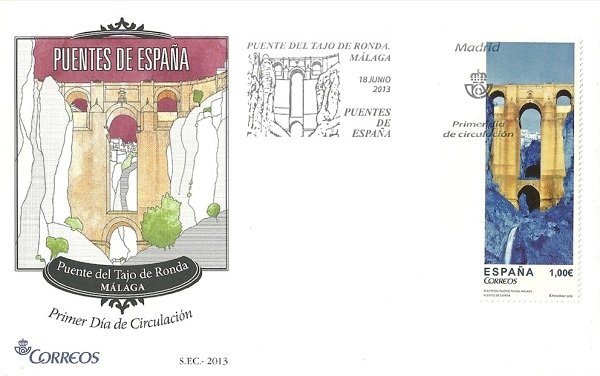
The Puente del Tajo, also known as Puente Nuevo, is the most characteristic monument of Ronda (Malaga). It was built between 1751 and 1793 over a 100 meters deep chasm made by the Guadalevin river. Its huge pillars settle deep into the gorge supporting a first central arch at the bottom which holds a much higher second one reinforced by buttresses. The work is completed with two lateral arches grounded on the rock. Parts of the span column interiors were used as a prison and now house an interpretation centre. It connects the old and the modern neighbourhoods of Ronda.
 The bridge was built with blocks of stone from the river gorge and it is considered a masterpiece. The building works lasted over 40 years and were conducted by several architects though Jose Martin Aldehuela was the key figure who also built the Ronda bull fighting ring. Both buildings are symbols of the city.

The Puente de Piedra in Logrono was built by Fermin Manso de Zuniga. It opened in June 1884 and is 198 meters long. It has seven arches standing on cylindrical pillars to span the bulk of the Ebro river. On the same location there stood a former bridge believed to have been built by San Juan de Ortega, which is why the current one is also known as Bridge of San Juan de Ortega. Due to landslides and heavy flooding, the original bridge was rebuilt several times until it was finally decided to build a new one on the remains of the old one. In 1917 the width of the Puente de Piedra was expanded with the construction on both sides of concrete pedestrian sidewalks, allowing for an increase in traffic.

Stamp Issue: 2013.06.18

June 20, 2013

Verranzano-Narrows Bridge

The Verrazano-Narrows Bridge, between Staten Island and Brooklyn, New York, is the longest single suspension bridge in the world. It is named for Giovanni da Verrazano, Florentine explorer who discovered New York harbor in about 1524. The massive span features a double deck thoroughfare, each wide enough for six lanes of traffic. The diameter of the cables measures 1 yard-identical with those on the George Washington Bridge. The Narrows Bridge is important in that it by-passes New York City. A map, illustrated on the stamp itself, pinpoints the positions of the Bridge with its close relationship to Staten Island and Brooklyn and also Manhattan and Jersey City, New Jersey.
Stamp Issue: 1954

The Mackinac Bridge Connecting The Peninsulas of Michigan

The Mackinac Straits Bridge extends over the Mackinaw Straits between Mackinaw City and St. Ignace, Michigan. The Mackinac Straits connects Lake Huron and Lake Michigan. The total suspension length of the span is more than a mile and a half between the cable anchors. The principle of the suspension bridge is that it has three essential parts: towers, anchorages, and cables. Towers for suspension bridges are built of stone or steel. Anchorages secure the ends of the cables, and most often are built of concrete or masonry. Cables are the most important element of a suspension bridge, since they carry the horrendous weight of the roadway.
Stamp Issue: 1958

The Golden Gate Bridge

The Golden Gate Bridge has the longest single span in the world, and the tallest bridge towers. Each of the cables has a diameter of one yard, and is composed of 27 thousand wires. Foundations have been sunk to solid rock 100 feet below water. The two main cables, each a yard wide, are outlined for the entire length by electric lights-magnificent evening sight. The Golden Gate Bridge and the Oakland-Bay Bridge were under construction at the same time; the Golden Gate Bridge is considered one of the most attractive spans in the world. The wonder of the extraordinary length of the span and the way it fits in with the site, make it one of the most exhilarating of bridges.
Stamp Issue: 1998

The San Francisco-Oakland Bay Bridge

In 1928, a San Francisco delegation urged Congress to pass a bill authorizing a bridge to connect San Francisco with Oakland and Berkeley-with 5 miles of water between. The legislation was defeated, but in 1932 Congress approved a $73 million loan with the endorsement of President Herbert Hoover. The first shovel broke ground in 1933, and 3 years later the span was opened to vehicular traffic with excited celebration. After competing ferries cut their fares in half in 1927, the bridge traffic amounted to 23 thousand vehicles a day. With the opening of the Golden Gate Exposition in San Francisco in 1939, tolls were reduced from 50 to 40 cents, and when cut further to 25 cents, the ferries gave up.

The roadway was built on two suspension bridges, with a central pier or anchorage at mid-channel. There are two decks: the top one handles six lanes for cars and light truck traffic. The lower deck carries three lanes for heavy trucks and multi-wheelers. There are also two streetcar (trolley) tracks provided. The structure is a combination of suspension and cantilever spans connected with a tunneled island.

Stamp Issue: 1939

The George Washington Bridge

The George Washington Bridge, over the Hudson River and dividing New York and New Jersey, is likely the heaviest and busiest of suspension bridges. Crossing the Hudson River at 178th Street, it is designed to carry huge loads. Twenty thousand tons of riveted steel for each tower was erected by massive derricks. Sixteen columns of steel 635 feet above water, as high as the Washington Monument, were put up.

The steelwork was planned early as a skeleton, and was to be covered by concrete and granite. However, as the steel skeleton rose, story by story, the unexpected attractiveness of the exposed steelwork fascinated virtually everyone who witnessed it. Consequently, massive appeals arose to "forget the masonry" that had been planned for the towers. Each of the four cables holding up the deck is a yard in diameter and a mile long. The 100,000 miles of wire could encircle the globe four times. Construction began in 1927 and continued for the next 4 years. Provision was made for an additional (lower) deck, which has since been added. The bridge opened to traffic in 1931. Of course it honors the name of the great General who managed to form the thirteen original colonies into one United States.

Stamp Issue: 1952

The Peace Bridge

The Peace Bridge has been significant in the growth of the country. It crosses the Niagara River from Buffalo, New York to Fort Erie, Ontario, Canada. The stamp commemorates more than a century of friendship, trade, and peace between the United States and Canada. The two nations share the longest undefended border in the world. New advances in construction have been used.

The Peace Bridge was built for pedestrian and vehicular traffic. Clearance at one end of the span is for canal or ship movement. The bridge is made up of five steel arches and a single truss span. At the elaborate opening ceremonies in 1927 a number of luminaries attended, including Edward, Prince of Wales.

Stamp Issue: 1977

The Brooklyn Bridge

In l869, actual construction of the Brooklyn Bridge, over the East River between Brooklyn and Manhattan, started. John Augustus Roebling, original architect of the project, was injured in an accident. Blood poisoning resulted in his untimely death. Fortunately his son, Colonel Washington Augustus Roebling, took over direction of the work involved from then on until completion. The grand opening was in May 1883.


This great bridge handles two elevated railroad tracks, two streetcar (trolley) tracks, road lanes for vehicles, and even a foot walk for pedestrians. Just to observe the massive stone towers one is in awe of their height. They had to be lofty to carry the cables which in themselves-wire by wire-measured 16 inches in diameter. Tons of steel wire had to be used to hold up the incredibly heavy bridge deck.
With the long main span, and two shorter spans, the bridge is 1 mile long. It is constructed of four cables, each anchored to plates of many tons, embedded in masonry foundations. Each foundation has a weight of 44 thousand tons. Every cable contains more than five thousand steel wires-a total of fourteen thousand miles of wire. It took thirteen years to build the bridge. At present thousands cross it each day. Even this writer, when working in New York, walked across this Bridge with friends and couldn't help but marvel at the magnificence of it all.

Stamp Issue: 1983